

Zulu!
The Hollywood Myth vs. Tactical Reality

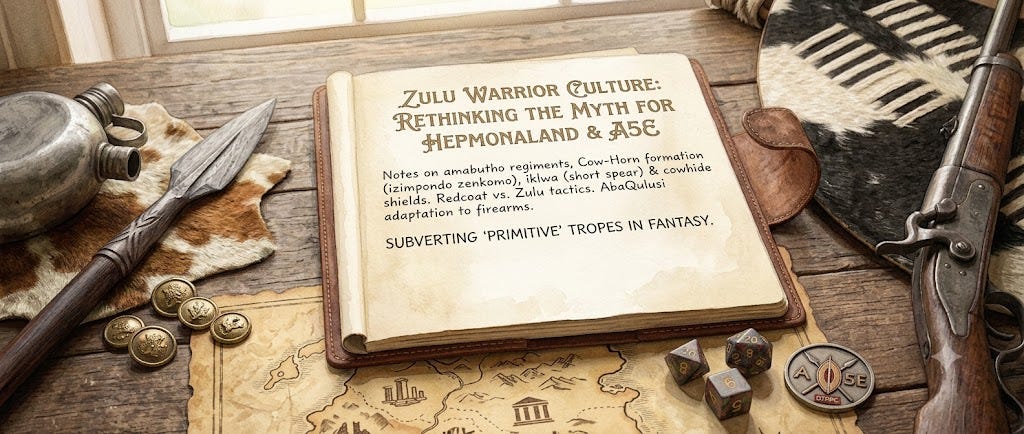
While on a creative roll, my thoughts turned to one of the most iconic warrior cultures on the African continent: the Zulu. Much of our collective modern imagination is anchored in Cy Endfield’s 1964 cinematic classic Zulu—a personal favourite of mine, but one that heavily perpetuates a flawed, reductionist narrative. Pop culture frequently flattens the Zulu military into a “primitive” or purely reactionary force: waves of traditional warriors wielding basic spears and cowhide shields, charging blindly into lines of disciplined British Redcoats.
Excellent deep dives from channels like Africa History Extra, Red Coat History, and The History Chap paint a radically different, far more sophisticated picture. The Zulu army was structured into highly organized, tightly disciplined state regiments (amabutho). While they utilized the traditional cowhide shield and specialized spears—such as the lethal iklwa (the short, close-quarters stabbing spear) alongside the longer assegai—their true power lay in their mastery of tactical manoeuvrability. Most notable was the famous “cow-horn” formation (izimpondo zenkomo), a brilliant tactical doctrine where the “chest” of the army pinned the enemy vanguard while the “horns” rapidly swept around to envelop the flanks, all supported by a tactical reserve known as the “loins.”
Adaptation, Firearms, and the abaQulusi
Although Zulu military culture was deeply rooted in the prowess and personal honour of close-quarters shock combat, they were never static or blind to technological evolution. Early in their history, there was a clear strategic recognition of the power of gunpowder. Far from eschewing firearms, specific regional groups actively integrated them into their tactical ecosystem.
A prime historical example is the abaQulusi—a highly autonomous royal section of the Zulu nation. They masterfully incorporated firearms into their traditional combat formations, developing exceptional marksmanship and flexible skirmishing tactics. At the turn of the 20th century, when Boer commandos raided their ancestral lands during the Anglo-Boer War, the abaQulusi fought back with devastating efficiency, securing stunning victories against heavily armed European forces.
While the British Empire ultimately prevailed across the broader Anglo-Zulu conflicts, they did so only after suffering catastrophic defeats (like Isandlwana) and being forced to completely overhaul their own battlefield tactics. The British success didn’t stem from fighting a “primitive” enemy; it came from finally realizing they were facing a brilliant, highly adaptable military machine.
Subverting the “Primitive” Trope in Fantasy Worldbuilding
What does this historical reality mean when we sit down to write or design fantasy cultures?
First and foremost, it completely shatters the lazy “primitive culture” trope. Societies do not exist in a vacuum, nor do they stay frozen in technological or tactical stasis. When we design fantasy worlds—especially those where collective belief, ancestral lore, and cosmic alignment possess literal, tangible power—concepts like martial honour and ritual combat aren’t just cultural flavour. They are practical, defensive assets that can shape reality itself.
More importantly, the history of the Zulu reminds us to ask an essential worldbuilding question: How would this culture have naturally evolved if an aggressive imperial neighbour (whether the British Empire or your setting’s dominant expansionist medieval kingdom) hadn’t interfered? Without external colonial disruption, these cultures would develop along entirely unique technological, magical, and sociological trajectories. They might merge gunpowder with indigenous magic, or evolve their shield-wall tactics to counter low-flying fantasy monsters.
The Gaming Mechanics: A New Martial Tradition
To ground this philosophy into gameplay, we can translate these tactics into a dedicated Martial Manoeuvres School tailored for Level Up: Advanced 5E (A5E).
Focus: This combat tradition specializes in the seamless, synergistic use of the spear and shield.
Versatility: Rather than trapping this style in a single, exoticized corner of the map, it should be designed as a universally applicable martial philosophy taught by elite mercenary bands, royal guards, or vanguard legions anywhere in the campaign setting.
Mechanics: (For the complete mechanical breakdown, feature list, and manoeuvres see Circle of One on DTRPG).
Designing for Hepmonaland and Beyond
Ultimately, the goal of exploring this history isn’t just to extract a few novel combat mechanics or point to a “cool way of fighting.” It is about a deeper commitment to cultural diversity and historical nuance in game design.
By stepping outside of Eurocentric fantasy defaults and genuinely studying how real-world societies adapted, fought, and thrived, we gain the tools to build far more vibrant, believable, and breath-taking fictional worlds. These reflections are directly guiding my current creative overhaul of Hepmonaland, ensuring it moves away from dated, stagnant clichés and emerges as a dynamic region filled with complex histories, evolving nations, and sophisticated military traditions.